
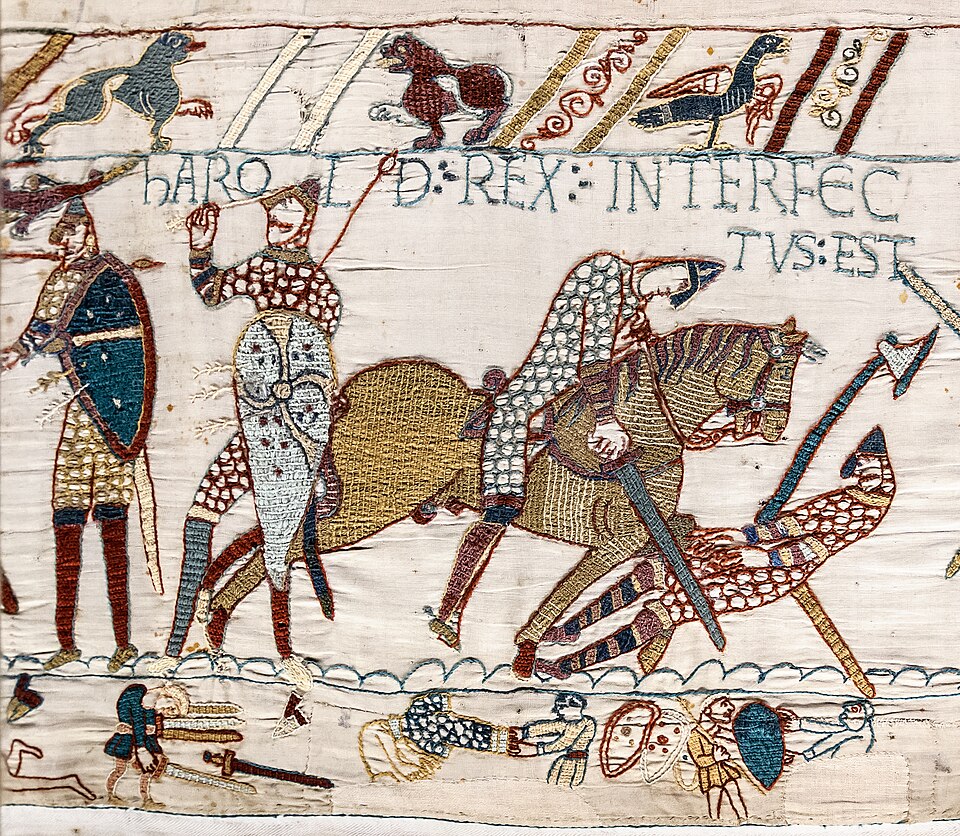
Pic from https://commons.wikimedia.org/wiki/Bayeux_Tapestry
The Bayeux Tapestry Comes to England
The Bayeux Tapestry, an embroidery depicting the 11th century Norman Conquest of England, has long been cared for in France, where it was traditionally known as Queen Matilda’s Tapestry.
Now it has come to England, on loan to the British Museum, to be exhibited from September 2026 to July 2027.
Origins
The tapestry is believed to have been created In the 11th century, when textile wall hangings were popular – albeit luxury – items. It is crafted from linen and wool, natural fibres inclined to biodegrade – hence the rarity of its survival.
In the 18th and 19th centuries, the artwork was considered ‘primitive’. I have to say, I disagree. I think that the artistry is highly skilled, depicting characters with vivid body language, and battle scenes with a strong sense of action. It is a powerful masterpiece.
Treasure of Information
Furthermore, the tapestry depicts historical events, and is a treasure trove of information about clothing, weapons, and daily life of the period. Hence, it is listed on UNESCO’s ‘Memory of the World’ international register.
Having survived for so long, the tapestry has been long studied, by many academics. All are very learned, all have their opinions – and often, they vary.
The story: the Norman Conquest of England
The storytelling is both clear and mysterious. It begins two years before the Norman Conquest, and features Harold Godwinson, Earl of Wessex, who later, in January 1066, became King Harold II of England.
In 1064, Harold made a journey to Normandy, a Duchy ruled by Duke William, then known as ‘the Bastard’, because his parents hadn’t married.
Most historians consider the Tapestry’s strange starting point is intended to explain why Duke William felt justified in invading England.
In other words, it is Norman spin. And a good reason for the centuries – long belief that William’s wife, Matilda, was responsible for creating the tapestry.
Norman Propaganda – made in England
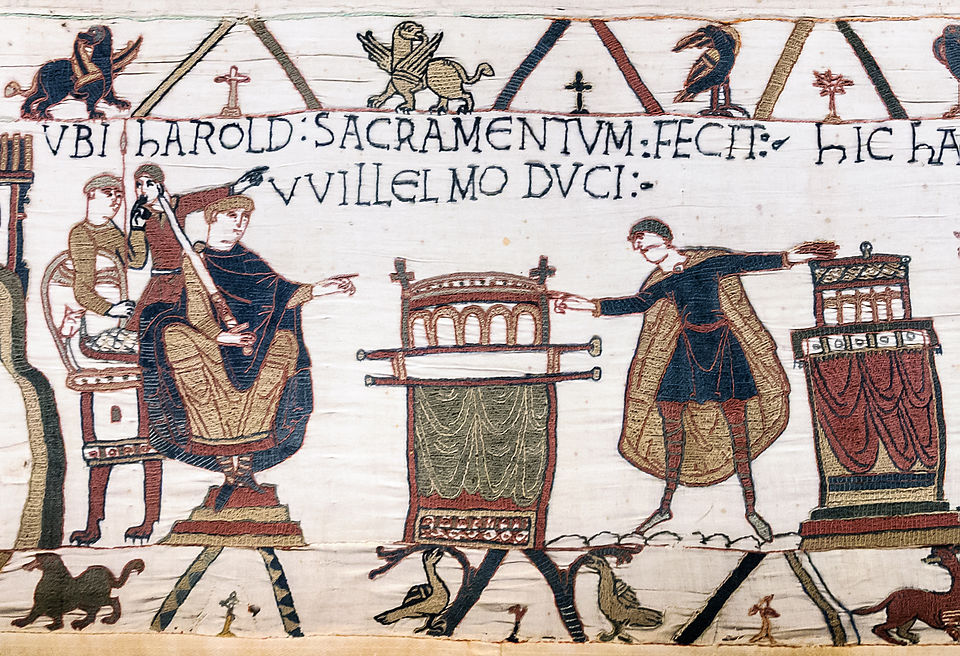
Pic from https://commons.wikimedia.org/wiki/Bayeux_Tapestry
Modern studies believe that the tapestry was commissioned in England – possibly by William’s brother, Bishop Odo. It’s thought to have been embroidered in Kent, probably – despite the many penises in the tapestry – by nuns.
The key scene depicts Harold, hands on reliquaries, swearing an oath to William.
Reliquaries – remains of saints – were powerful religious objects. To break an oath sworn on one was very, very bad. In today’s terms, it might be compared to breaking a contract in which the penalty was death, followed by consignment to hell. Not good.
Unspoken
What the tapestry does NOT tell us, is, what oath did Harold make?
Historians’ interpretations vary. Generally, it is thought that Harold swore some kind of fealty, vassalage, or confirmation that William was the legitimate successor to King Edward of England.
Whatever Harold swore, William justified his invasion upon the fact that Harold betrayed this oath, hence was a perjurer and traitor – and certainly not rightful King of England.
Mysteries
The tapestry contains more mysteries. It does not explain Harold ‘s motivation for visiting Normandy, where he was initially taken hostage. And when Harold arrives at William’s palace, a caption above a woman reads ‘Where a Cleric and Aelfgyva’.
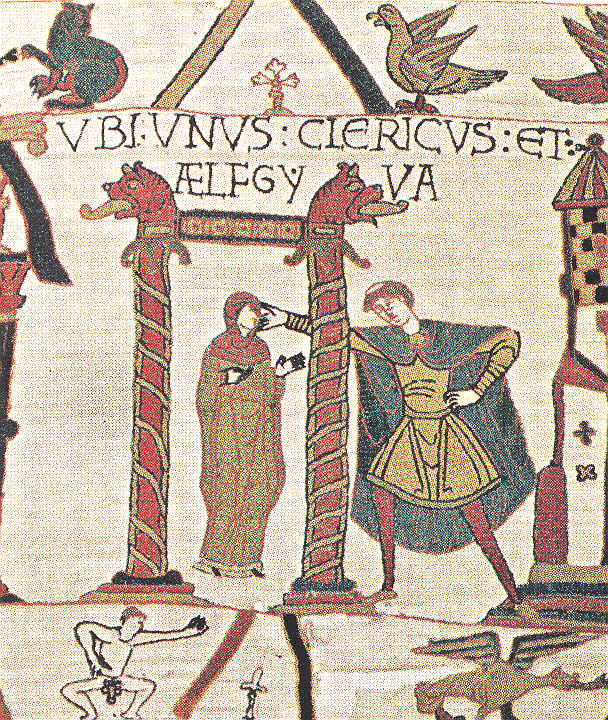
Pic from https://commons.wikimedia.org/wiki/Bayeux_Tapestry
Who is Aelfgyva?
Who is the cleric? Who is Aelfgyva? Presumably, at the time, ‘everyone’ knew her identity. Nearing a thousand years later, it’s harder to know. Aelfgyva is the Latinised spelling of Aelfgifu, a popular English name at the time. Hence, there are many Aelfgifus.
King Canute, the Danish conqueror who ruled England from 1016 to 1035, had two wives, both named Aelfgifu. Is the mystery woman one of these? Cnut’s first wife, Aelfgifu of Northampton, was a Mercian noblewoman.
Cnut’s second wife, also known as Emma of Normandy, was a member of the Ducal family. As a teenager, she was married to King Aethelred ‘The Unready’ of England, to seal a diplomatic deal with Normandy. On her marriage, Emma was given the English name of Aelfgifu. She bore Aethelred three children, and when Cnut invaded England, Emma took her children to Normandy for refuge.
She later married Cnut. Records use wording such as ‘Cnut summoned her’, implying she had little choice in the matter. For their safety, Emma/Aelfgifu left her children in Normandy. It was a real fear: Cnut’s reign began with executions and assassinations, eliminating all who might oppose him.
Hence, Emma’s son Edward grew up in Normandy, speaking French. After Cnut died, both his sons, one by each wife, became king. After each died young and childless, the English nobles invited Edward to return from Normandy.
Hence, this Aelfgifu had reason to be in Normandy. But is she the woman in the tapestry? Why is a cleric touching her face? It’s a strange thing, hinting at scandal. In the border beneath, a naked man displays his genitals. Is this relevant? What is the artist trying to say?
Royal Blood
If the mystery ‘Aelfgyva’ is Emma of Normandy, this hint of scandal could be subversive, because it was through Emma that William staked his ‘blood right’ to the throne of England. It was tenuous – she was his grandfather’s sister. But, it was a family connection.
Harold had no blood connection to Edward – he was brother to the King’s wife. However, he could claim royal blood through his mother, who was kin to King Cnut. Harold was cousin to the current King of Denmark, Swein Estrithsson.
Women in the Tapestry
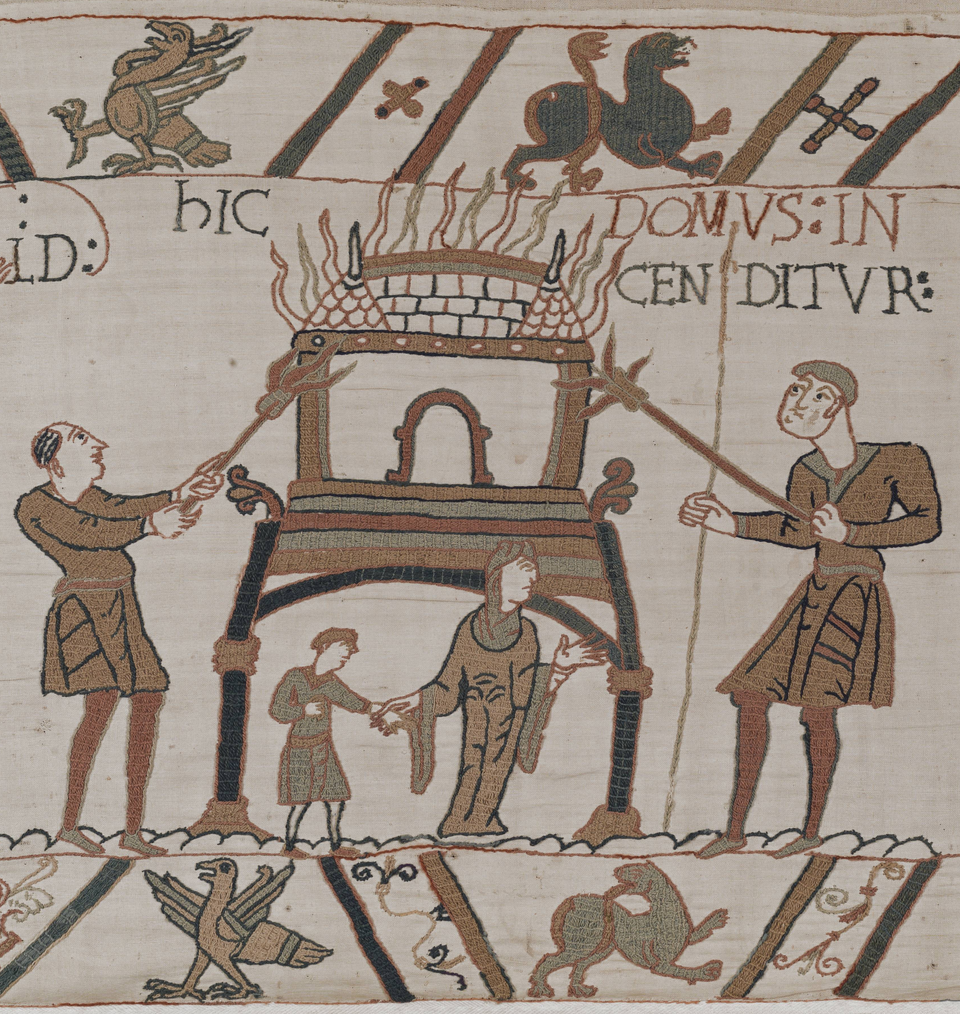
Pic from https://commons.wikimedia.org/wiki/Bayeux_Tapestry
The mystery Aelfgifu is one of only three women portrayed in the tapestry’s main narrative. The others are Edward’s wife and Queen, Edith, daughter of Godwin. The third is an unnamed woman fleeing a burning house – the ravaging tactics that William used to such devastating effect.
Silent resentment
The English did not welcome William. Written records from the time are reticent and fearful, but it’s a fact that William spent years fighting English rebellion.
Some commentators believe that silent resentment is reflected in the borders of the tapestry. They are a riotous miscellany: birds, people, action scenes. Some represent every day life. Some are obscene, such as the naked man clutching his genitals. (Sewn by nuns?!) Some are thought to be iconography of stories such as Aesop’s fables. Others project the brutality of battle: dead men stripped of their valuables.
Why are these things here? Are they decorative? Or are they, as some analysts suggest, a subversive commentary, by English artists, on the foreigners who invaded and occupied, brutally enforcing their rule?
The missing bit
There’s a final mystery at the end of the tapestry.
It’s widely believed that the tapestry is missing its end. What might this show?
Worth looking
The tapestry repays study on many levels. It’s a magnificent artwork in its own right. It tells a dramatic story. It’s 11th century propaganda.
It’s endlessly fascinating.
It’s well worth a look. The more you look, the more you will see.